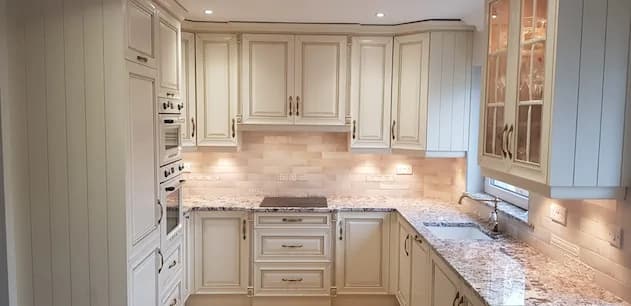
The extractor hood is the appliance everyone forgets until the first fry-up fogs the windows. In an Irish home, where houses are better sealed than they used to be and the kitchen is often open to the living space, good ventilation protects your cabinets, your walls and the air you breathe. At Creo Interiors, we plan the extraction at the same time as the layout, so the hood becomes a deliberate part of the design rather than an afterthought, whether the room is a contemporary kitchen or a classic painted one.
1. Start With How You Cook
Before choosing a style, think about what the hood actually has to do. A household that fries, roasts and cooks big family meals needs far more extraction than one that mostly reheats and boils.
- Extraction rate: as a rough guide, look for a hood that can move the room's air volume several times an hour, and remember that higher power usually means a bigger duct.
- Noise: check the sound level on the lower speeds, as that is where you will use it most.
- Ducted or recirculating: ducting to the outside is far more effective; recirculating hoods with carbon filters are a fallback where an external wall is out of reach.
2. Hood Styles That Suit Modern Kitchens
Contemporary schemes tend to hide or minimise the hood so the cabinetry stays calm and uncluttered.
- Ceiling extractors sit flush above an island hob and almost vanish when switched off.
- Downdraft extractors rise from the worktop behind the hob and drop back down when finished, ideal under a window or on an open-plan island.
- Integrated canopy hoods slide out from inside a wall cabinet, keeping the door line unbroken in matt lacquer or timber veneer.
3. Hood Styles That Suit Traditional Kitchens
A traditional kitchen can make a feature of the extraction. A bespoke chimney canopy in the same painted finish as the cabinets, finished with a cornice and a simple moulding, gives the hob a proper focal point and echoes the old range alcove.
The secret is to build the canopy as joinery. We make them in our workshop to match your traditional kitchen exactly, with the motor hidden inside, the ducting concealed above and a tidy cabinet either side. The result looks like it was always part of the house.
4. Planning It Properly
Extraction is easiest to solve on paper. The position of the hob, the route of the duct, the wall or ceiling it passes through and the power supply all need to be agreed before the first cabinet is ordered. If you're also deciding on ovens and fridges, our guide to integrated kitchen appliances shows how it all fits together.
Kasia and Tomek will go through the options with you at our Celbridge showroom, where you can see how different hood styles look against real doors and worktops, and you can request a design quote when you're ready.
Ready to Clear the Air?
A well-chosen extractor keeps your kitchen fresh and looking its best for years, and it can be a beautiful part of the design too. Creo Interiors designs and builds bespoke kitchens in both modern and traditional styles, with ventilation planned in from the start.
Contact Creo Interiors today to book a consultation and start planning your kitchen.