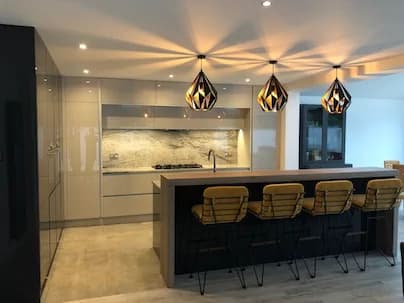
Worktops get chosen first and talked about most, but it's the cabinet doors that decide how a kitchen reads from the doorway. Roughly eighty per cent of what you see when you walk in is door front. At Creo Interiors we manufacture every style in our own workshop, so the choice is never limited by what a supplier happens to stock — and that means it's worth understanding what each option actually gives you before you commit.
Handleless: The Cleanest Contemporary Line
A handleless kitchen removes the last piece of visual clutter from the run. There are two ways we build them, and they behave quite differently in daily use.
- Gola profile — a recessed channel runs behind the door edge, giving you a continuous shadow line and a comfortable grip at every unit. Best for full runs and tall banks.
- J-pull — the grip is routed into the door itself, so there's no separate channel to clean. Slightly softer looking, and it works well on islands.
- Push-to-open — reserved for doors with no natural grip point, such as a slim appliance panel.
Matte lacquer is the finish that suits this style best. It absorbs light rather than bouncing it, which keeps a large uninterrupted expanse of cabinetry from feeling flat or clinical.
Shaker: Why It Never Dates
The Shaker door is a five-piece frame around a flat centre panel — an honest bit of joinery that has outlasted every trend thrown at it. Its strength is proportion. A narrow 57mm frame reads as crisp and almost contemporary, while a wider frame gives a more farmhouse, country feel.
The detail most people miss is the paint. We hand-finish Shaker doors in the client's chosen shade rather than working from a fixed range, which means the cabinetry can be matched to an existing hallway colour or to the tone of a stone floor. Painted timber can also be refreshed a decade from now, something no foil-wrapped door will ever offer.
In-Frame: The Craftsman's Choice
In-frame cabinetry sets the door inside a solid timber face frame, so the frame stays visible around every opening. It's the most demanding style we build — tolerances are unforgiving and every carcass has to be square to the millimetre — and it's the one that most clearly announces that a kitchen was made rather than assembled.
The reward is depth. Shadow lines fall differently across an in-frame run, and the whole wall gains a furniture quality that suits period homes across Kildare beautifully. Pair it with a butler sink and a wide painted larder and the room looks like it has always been there.
Handles: The Detail That Ties It Together
Hardware is the jewellery of the kitchen and the cheapest thing to get wrong. A few principles we follow:
- Bar handles stretched to a generous length flatter long drawer fronts; short handles on wide drawers look mean.
- Cup pulls and knobs belong together — cups on drawers, knobs on doors — and they suit Shaker and in-frame framing naturally.
- Brushed brass warms a cool palette; matte black sharpens a pale one; antique bronze softens both.
Kasia and Tomek keep a full board of samples in the Celbridge showroom precisely because handles have to be held, not scrolled past on a screen. Weight and finish tell you more in five seconds than a product photo will in five minutes.
See the Doors in Person
Handleless, Shaker or in-frame — each one changes how a room feels, and there's no substitute for opening them yourself.
Contact Creo Interiors today to arrange a visit to our Celbridge showroom, where our team will help you match a door style to your home and your budget.