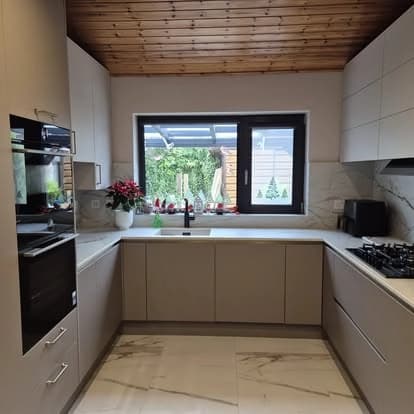
The splashback is one of the last decisions clients make, and one of the most powerful. It sits at eye level, directly behind the hob and sink, and it is the surface guests notice while you are making the tea. Get it right and it ties the cabinetry and worktop together into a single, considered design. Get it wrong and it fights everything around it. Here is how we guide clients at Creo Interiors through the options.
Full-Height Stone: The Seamless Modern Choice
Running your worktop material straight up the wall is the cleanest look available, and it has become the default request in our contemporary projects. Quartz, Dekton and porcelain all work beautifully here, and because the veining continues from the counter to the underside of the wall units, the eye reads the whole run as one uninterrupted piece.
There is a practical argument too. No grout lines means no scrubbing. A single wipe clears splashes from the hob, which matters enormously behind a busy family cooker. If your budget allows only one upgrade, this is the one that gives back every day.
Glass Splashbacks: Colour Without Compromise
Toughened glass is the option to reach for when you want a hit of colour that no tile range can quite deliver. It can be painted to any shade you like, so a soft sage, a deep ink blue or a warm clay tone can be matched precisely to the cabinetry rather than approximated.
Glass also bounces light around, which is a genuine advantage in the narrower galley kitchens common in older Dublin and Kildare houses. Where a wall of dark tile would close the room down, a glass panel keeps it feeling open and reflective.
Tiles for Traditional and Transitional Kitchens
For painted Shaker and in-frame cabinetry, tile is still the most sympathetic finish. Hand-glazed metro tiles with their slightly uneven surface catch the light in a way that flat porcelain simply cannot, and the texture sits perfectly alongside timber and hand-painted doors.
The layout matters as much as the tile itself. A herringbone or stack-bond arrangement lifts a simple white tile into something far more deliberate, while a contrasting grout adds definition without shouting. Zellige and handmade-look tiles are having a real moment with our clients who want warmth and character rather than showroom perfection.
Making the Splashback Work With Everything Else
A splashback never exists on its own. It has to sit comfortably between the worktop below, the cabinet colour on either side, and crucially the lighting above. Under-cabinet LEDs will wash directly down the surface and exaggerate every texture, so a heavily patterned stone can look busy once the lights go on.
We also plan sockets and extractor positions at design stage rather than leaving them to the fitters. Kasia and Tomek will always talk through where the kettle lives, where the plugs need to land, and how the splashback meets the window reveal, because those small details are what separate a bespoke kitchen from a fitted one.
See the Options in Person
Photographs only take you so far with surfaces. Colour, reflectivity and texture all need to be seen in real light, alongside the door finish you are considering.
Contact Creo Interiors today to visit our Celbridge showroom, where you can compare stone, glass and tile samples against our full range of contemporary and traditional cabinetry.